
Creating a Community Coffee & Veg Cart
Rationale
The Coffee and Veg Cart project at Mayflower Community Academy is grounded in a clear belief that learning should be purposeful, applied and deeply connected to the world beyond the classroom. As part of the school’s wider approach to project-based learning, pupils engage in designing and delivering a real product that serves their community. Projects at Mayflower are carefully planned to achieve meaningful goals, often involving research, collaboration and real-life application. This initiative builds on that model by positioning pupils as active contributors - designing, growing, sourcing and serving products that meet genuine needs within their school and local environment.
The rationale behind the project also reflects a commitment to developing pupils’ understanding of sustainability, enterprise and ethical decision-making. By combining a coffee and vegetable offer, the project provides opportunities to explore where food comes from, how it is produced and how it can be shared responsibly. Pupils are encouraged to think critically about pricing, sourcing and value, building an early understanding of economic participation and environmental responsibility. Through this, learning becomes interdisciplinary—drawing on mathematics, design technology, science and PSHE - while remaining rooted in authentic, tangible outcomes.
For pupils, the benefits are both academic and personal. The Coffee and Veg Cart enables children to apply core skills such as number, communication and problem-solving in a real-world context, strengthening both understanding and retention. At the same time, it develops key life skills including teamwork, organisation, resilience and leadership. Pupils take on meaningful roles within the project, contributing to planning, production and delivery, which builds confidence and a strong sense of ownership over their learning. This is particularly powerful in supporting inclusion, as it creates varied entry points for success and values a wide range of strengths and talents.
The impact on the wider community is equally significant. By engaging with local suppliers, families and community partners, the project helps to strengthen relationships and create opportunities for meaningful collaboration. Mayflower’s vision emphasises working with the wider community to broaden horizons and provide high-quality learning experiences. The Coffee and Veg Cart embodies this by creating a shared space where the school and community come together - whether through purchasing products, contributing to the supply chain or supporting the project’s development. It reinforces a sense of belonging and collective responsibility, positioning the school as an active and valued part of the local area.
Ultimately, the project exemplifies Mayflower’s commitment to creating memorable, high-impact learning experiences that extend beyond traditional classroom boundaries. It ensures that pupils not only acquire knowledge but also understand how to use that knowledge to make a positive contribution to their community. Through initiatives such as the Coffee and Veg Cart, pupils are equipped with the skills, values and confidence needed to thrive-both within school and in the wider world.
If you are reading this and would like to get involved - do email us on school.office@mayfloweracademy.co.uk
We would love to hear from you.
Together we can...
Project Timeline
1. Design
2. Build
3. Use
Phase 1: Co-Design & Vision (Week 1–2)
Purpose: Build ownership and clarity before anything is built
Key Actions
- Share concept (coffee cart + veg stand) with staff + pupils
- Gather ideas (look, feel, name, purpose)
- Involve:
- Permaculture team
- Premises/site staff
- Small pupil design group
Outputs
- Agreed design direction (style + function)
- Named projects (e.g., “Mayflower Market Cart”)
- Initial sketches refined (like your current one)
Phase 2: Materials & Preparation (Week 2–3)
Purpose: Keep cost low and sustainability high
Key Actions
- Source reclaimed materials:
- Pallets (local businesses)
- Old decking/scaffold boards
- Wheels (bike repair shops)
- Sort + prepare:
- De-nail
- Sand rough edges
- Cut to rough sizes
Outputs
- Full materials ready
- Safe working area set up
Phase 3: Core Build (Week 3–5)
Purpose: Structural build (site team + selected staff)
Build Stages (Both Projects)
| Stage | Coffee Cart | Veg Stand |
|---|---|---|
| Frame | Base + upright frame | Simple rectangular frame |
| Mobility | Fit wheels & balance | Optional wheels/feet |
| Structure | Add sides, shelves | Add tiered shelving |
| Roof (cart only) | Install pitched roof | N/A |
Outputs
- Structurally complete builds
- Safe, stable, ready for finishing
Phase 4: Finishing & Identity (Week 5–6)
Purpose: This is where buy-in accelerates
Pupil Involvement
- Sanding
- Painting
- Branding
- Signwriting
Options
- Natural wood finish + oil
- Painted panels (school colours)
- Chalkboard surfaces
- Stencilled logos
Outputs
- Visually strong, identity-rich builds
- Clear link to school values
Phase 5: Launch & Use (Week 6+)
Purpose: Embed into daily life
Coffee Cart
- Launch morning event
- Weekly rota (staff/pupils)
- Use at:
- Drop-off
- Events
- Community days
Veg Stand
- Linked to harvest cycles
- “Market Day” routines
- Honesty box / donation system
Phase 6: Sustain & Grow
- Rotate pupil involvement
- Add seasonal decoration
- Extend:
- Bake sales
- Craft stalls
- Community contributions
MOOD BOARD (Design Directions)
Below are four strong visual directions you can choose from or blend:
1. Natural Permaculture Aesthetic
- Raw wood
- Visible grain, knots
- Jute rope details
- Chalkboard signs
- Crates + baskets
Feel: earthy, authentic, calm
Message: “grown, not manufactured”
2. Playful Primary / Pupil-Led
- Bright painted panels
- Hand-drawn signs
- Mixed colours
- Slightly imperfect (in a good way)
Feel: joyful, owned by children
Message: “this belongs to us”
3. Market Stall / Artisan
- Neutral tones (white, grey, sage green)
- Clean signage
- Uniform crates
- Striped canopy (optional)
Feel: professional, welcoming
Message: “trusted, high-quality”
4. Industrial Reclaimed
- Dark stained wood
- Exposed bolts
- Metal brackets
- Wheels emphasised
Feel: robust, crafted
Message: “built to last”
Illustration Mock Ups
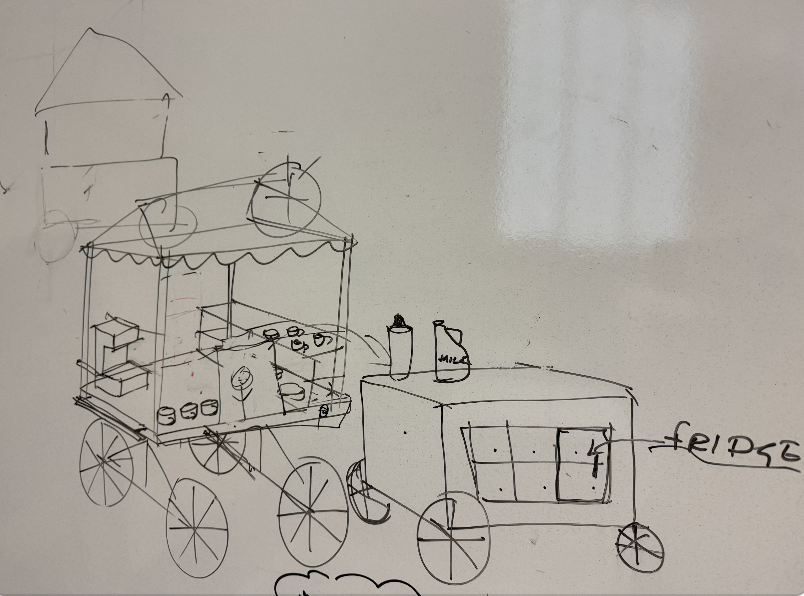
Draft created initially alongside a local designer from Plymouth University | Rudra
Coffee Cart – Style Variations
A. Natural Permaculture Style
canvas/wood roof
herbs
hanging plants optional
cart
- Hanging herbs / bunting
- Rough-sawn wood
- Chalk menu: “Today’s Brew”
Clean Market Style
- Painted panels
- Consistent colour palette
- Simple branding
Veg Stand – Style Variations
A. Rustic Tiered Display
- Crates staggered
- Handwritten labels
B. Clean Produce Stall
- Symmetry
- Labelled pricing
- Calm colours
HOW TO ACHIEVE CLEAR OUTCOMES THROUGH CREATIVE PROCESS
“This is about structures - it’s about culture”
Three clear outcomes:
1. Visibility of Learning
- Children see their work matter in the real world
2. Relational Engagement
- Coffee cart = conversations that don’t happen otherwise
3. Sustainability in Action
- Not taught… lived
Testimonial
“These are small physical builds, but they are high-impact cultural interventions. They sit at the school gate where our values are most visible.”