
Current Projects | Teaching, Learning and Assessment
I often think about work as a series of projects. Some are short, some are ambitious, and some evolve over years, but the projects that energise me most are those that combine challenge with genuine enjoyment. Whether the focus is teaching, learning and assessment, school improvement, inclusion, or wider locality development, I find motivation in bringing people together around a shared purpose and then working creatively to make something better than it was before.
Much of my day-to-day work involves tackling the complex and sometimes difficult areas of education. Strong systems, proven processes and evidence-informed practice matter greatly, and I am committed to following what we know works. At the same time, I believe that sustainable improvement is about more than process alone. I am fascinated by how we create meaning, understanding and engagement through thoughtful design, creativity and human-centred approaches. For me, the challenge is not simply implementing a system, but designing experiences, cultures and environments that help people thrive.
Alongside school leadership, I enjoy contributing to larger projects that stretch across organisations and sectors. Current interests include TEAM Plymouth initiatives, Trust-wide developments in artificial intelligence, and a range of personal projects that explore creativity, design thinking and ideas from outside education. Learning from different industries and disciplines helps me bring fresh perspectives back into schools and keeps my own thinking evolving.
Away from work, there is of course the ongoing and ever-important project of being a parent. It is the most rewarding, humbling and challenging role I have, and one that continually shapes my perspective on learning, relationships, community and what really matters.
Making Meaning
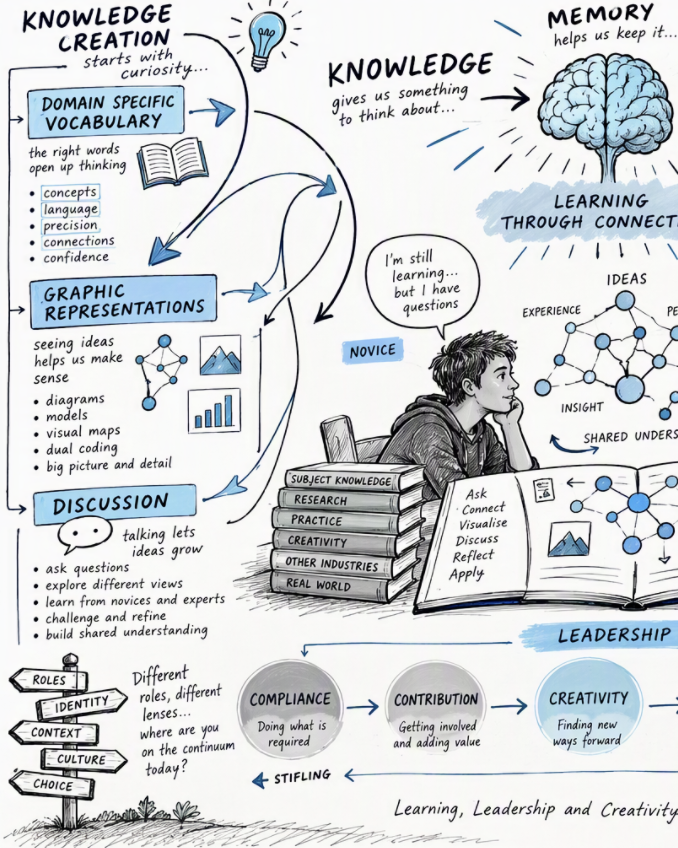
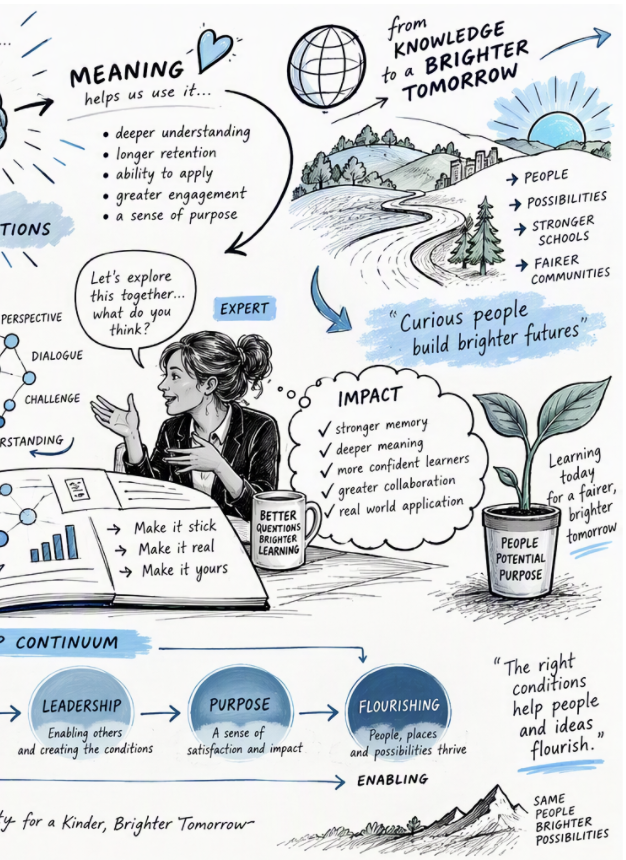
One area I am particularly interested in exploring is the relationship between knowledge, memory and meaning. I am fascinated by how people learn, retain and apply new ideas, and whether certain combinations of tools can significantly improve understanding over time. Rather than thinking about learning as the transfer of information, I increasingly see it as the creation of meaning through carefully designed experiences.
This year, one study project I am especially keen to pursue centres on the combination of domain-specific vocabulary, graphic representations of knowledge, and purposeful discussion. My hypothesis is that when learners are able to see important concepts visually, speak about them using precise language, and test their understanding with others who may view themselves as either novices or experts, learning becomes richer, deeper and more memorable. The intersection of language, imagery and dialogue feels like a particularly powerful area for exploration.
Leadership
I am continuing to explore the idea of leadership continuums and the roles we play within organisations and communities. I am interested in how different leadership identities create either a sense of purpose, satisfaction and enablement, or conversely, feelings of constraint and frustration. Understanding where individuals sit along these continuums, and how organisations can create conditions for people to flourish, is becoming an increasingly important strand of my thinking.
These areas sit at the crossroads of education, design, psychology, systems thinking and human development. They represent the kind of questions that keep me curious: how do people make sense of complex ideas, what helps knowledge stick, and how can we design environments where both learning and leadership feel meaningful?