
The Power of “Long and Short”: Why Teaching Relative Note Durations Matters in Primary Music Education
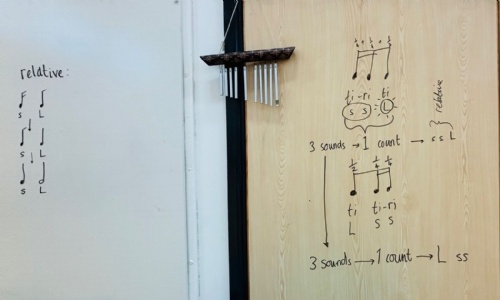
In primary school music education, our goal is not simply to teach children to decode symbols on a page, but to help them think musically. One of the most effective ways to do this - particularly within a Kodály-inspired curriculum - is by teaching note durations as relative rather than fixed.
Instead of presenting rhythms as abstract mathematical values, we describe them in musical terms: long and short, always in relation to one another. This seemingly simple shift has profound benefits for children’s musical understanding, sight-reading ability, and creative expression.
Understanding Rhythm Through Relationship
In our curriculum, rhythm is taught comparatively:
• A crotchet may feel “long” when placed next to quavers
• A quaver becomes “long” when compared to a semiquaver
• A semiquaver is “short” relative to almost everything else
This approach reflects how music actually functions. Rhythm is never experienced in isolation; it only makes sense in context. Children learn that note lengths do not exist as rigid values, but as part of an ongoing musical conversation.
This mirrors the Kodály principle that music learning should follow the way children naturally perceive sound - through listening, movement, comparison, and experience before theory.
Rhythm Syllables as a Bridge to Musical Literacy
Alongside relative durations, we teach rhythm syllables such as:
• ta
• ti-ti
• ti-ri-ti-ri
• ti-ti-ri
These syllables provide children with a spoken and embodied way to experience rhythm before reading notation. When rhythm is felt, spoken, clapped, stepped, and played, it becomes internalised rather than memorised.
Importantly, rhythm syllables reinforce relativity:
• ti-ri only makes sense when it is shorter than ti
• ta only feels long when something shorter exists beside it
Children are not counting fractions – they are recognising patterns of time.
Supporting Stronger Sight-Reading Skills
One of the greatest benefits of teaching relative note durations is the impact on sight-reading.
When children encounter new music, they are not required to calculate values or remember fixed definitions. Instead, they ask:
• Which notes are longer?
• Which are shorter?
• How do these rhythms relate to one another?
This comparative thinking allows pupils to chunk rhythm patterns quickly and efficiently. Rather than reading note by note, they begin to recognise familiar rhythmic groupings – much like recognising words instead of individual letters when reading text.
This leads to:
• Faster decoding of rhythm
• Greater confidence when approaching unfamiliar music
• Reduced cognitive overload
In essence, relativity turns rhythm reading from a mathematical task into a musical one.
Developing Musical Flow and Expression
Beyond accuracy, relative rhythm teaching supports something even more important: musical flow.
When children understand rhythm as movement through time – longer and shorter sounds working together – they begin to feel:
• pulse
• shape
• momentum
• phrasing
This understanding encourages expressive playing and singing. Music no longer sounds mechanical or fragmented, because children are not focused on counting each beat individually. Instead, they sense how rhythms travel and breathe.
As a result, pupils begin to:
• shape rhythmic patterns naturally
• perform with continuity rather than hesitation
• recognise when music feels rushed or heavy
• make expressive choices instinctively
These are foundational musicianship skills that extend far beyond the primary classroom.
Encouraging Creativity and Composition
Relative rhythm understanding also has a powerful creative benefit.
When children compose, improvise, or arrange rhythms, they are not limited by numerical rules. They think in musical contrasts:
• “What if this part is shorter?”
• “What if I repeat a long sound here?”
• “What happens if I change the rhythm flow?”
This gives children genuine compositional agency. They can experiment freely while still producing rhythms that make musical sense.
Because they understand how durations relate, their compositions often show:
• balance
• repetition and contrast
• rhythmic coherence
• intentional variation
Creativity becomes structured, not accidental.
Supporting Inclusive and Developmentally Appropriate Learning
Research and pedagogical practice consistently show that young learners grasp comparative concepts more easily than abstract ones. Children understand longer and shorter long before they understand fractions or formal note values.
Teaching rhythm relationally therefore:
• aligns with cognitive development
• supports pupils with additional learning needs
• reduces anxiety around “getting it wrong”
• allows success at multiple ability levels
Every child can feel and compare rhythm – even before they can read it.
Laying Foundations for Future Musical Learning
Importantly, teaching relative durations does not replace traditional notation – it prepares children for it.
When formal note values are later introduced, pupils already understand:
• proportional relationships
• rhythmic hierarchy
• subdivision
• metric structure
The symbols finally have meaning because they represent something already experienced physically, aurally, and emotionally.
This reflects the heart of Kodály philosophy:
Sound before symbol, experience before explanation.
In Summary
Teaching relative note durations in primary music education:
• strengthens sight-reading skills
• supports rhythmic fluency
• encourages expressive performance
• deepens creative thinking
• aligns with child development
• builds strong foundations for musical literacy
By focusing on how rhythms relate to one another, we help children move beyond simply playing the right notes at the right time – and toward truly understanding music as a living, flowing language.
When children think in terms of long and short, comparison and contrast, they are not just learning rhythm.
They are learning how music moves.